



Dear neurokin,
It was refreshing to see some wise words, amongst the nonsense and noise on instagram this week. My time spent there is fleeting these days. Reading these words felt like a relief:
A boundary isn’t something that you set. It is something that grows.
It felt like a relief because it was acknowledgment that boundaries and the self belief it takes to know it’s ok to make them is no easy thing.
Receiving advice over and over that ‘you need to set a firmer boundary’ feeds the feeling that ‘there’s something wrong with me’… ‘why can’t I just do it like everyone else ’
Here’s why boundary setting can be difficult for many neurodivergent people.
‘I’m a recovering People Pleaser’
I used to say this as a joke. All that I had read and understood had minimised the damage of being a people pleaser. Like many other women that I know, I had considered the people pleaser to be casual, breezy and sweet. The ‘nice girl’ or ‘good woman’ who will do whatever is required to keep everyone else happy.
Throughout my life I’ve heard people describe me as ‘no trouble’ ‘really easy to be around’ ‘flexible and adaptable to the needs of others’.
For much of my adult life I have described this as a personal strength. Something that I took pride in.
Because I was conditioned to do so.
By society, family, education, employment, hell, its a built into the whole gender bias of what is expected of women and girls:
Behave ‘well’ don’t rock the boat or cause problems
Quiet - soft, gentle, neat and restrained
Compliant - co operative, follow rules, don’t question authority
People pleasing is a conscious or learned habit of keeping others happy to gain validation or avoid conflict.
Fawning is a trauma response
Fawning is an involuntary trauma and nervous system response where your brain automatically appeases others to prevent perceived danger. Often causing you to completely abandon your own needs.
Last year I started working with an amazing therapist who specialises in NARM (NeuroAffective Relational Model) it helped me to understand that I was using fawning as a survival pattern.
This has totally altered my understanding of people pleasing and what causes it to tip into the anxiety response of fawning. I can no longer minimise the dark side of living your life to be the ‘easy going’ malleable human who doesn’t consider or express your own needs.
It was a shocking wake up call for me to fully grasp that this fawning blue print had been set in my formative years. As my nervous system understood it, my survival was dependent on never expressing my own difficulty or needs. At all times, it had become a survival technique to place the needs of others ahead of my own.
Somewhere in my psyche I had messaged myself that I would only be loved or lovable if I was easy going, low maintenance, with limited demands on what I needed from others.
It felt dangerous to complain, to share anything I found difficult or to ask for what I needed.
I wonder how many of you, dear neurokin, have had a similar experience?
If from an early age you sensed that you were different but had no information or language to understand or explain this, the anxiety response may have been to minimise yourself by fawning.
How do you change your safety blueprint?
Often I feel that I have no place to comment on this, that this must come from the ‘professionals.’ That’s its only for respected Psychotherapists to share their tools in their podcasts and writing.
I am coming to recognise that my contribution is in my writing or speaking about how life feels. How it feels to learn about living well beyond neurodivergent discovery; to grow from it, to make changes that improve how fulfilling life is to live.
It’s more than setting boundaries
Fully grasping how much fawning has led me to live my entire life to please others, how much it has taken away from living life for myself, has rocked the foundations of my world.
Those foundations weren’t built for me, they were built for safety and to serve others.
Seeing those words from Emma Svanberg about a boundary not being something you set. It is something that grows, has inspired me to write to you today about something I consider fundamental and required to be able to create boundaries; the foundation on which you can fully grow to live your life well; self esteem.
To understand and love yourself enough to believe you deserve to live well.
What has been the best change to happen in your life as a result of embracing your neurodivergence?
I recently asked this question on a Substack note. This response from Sarah E Boon - Author blew me away.
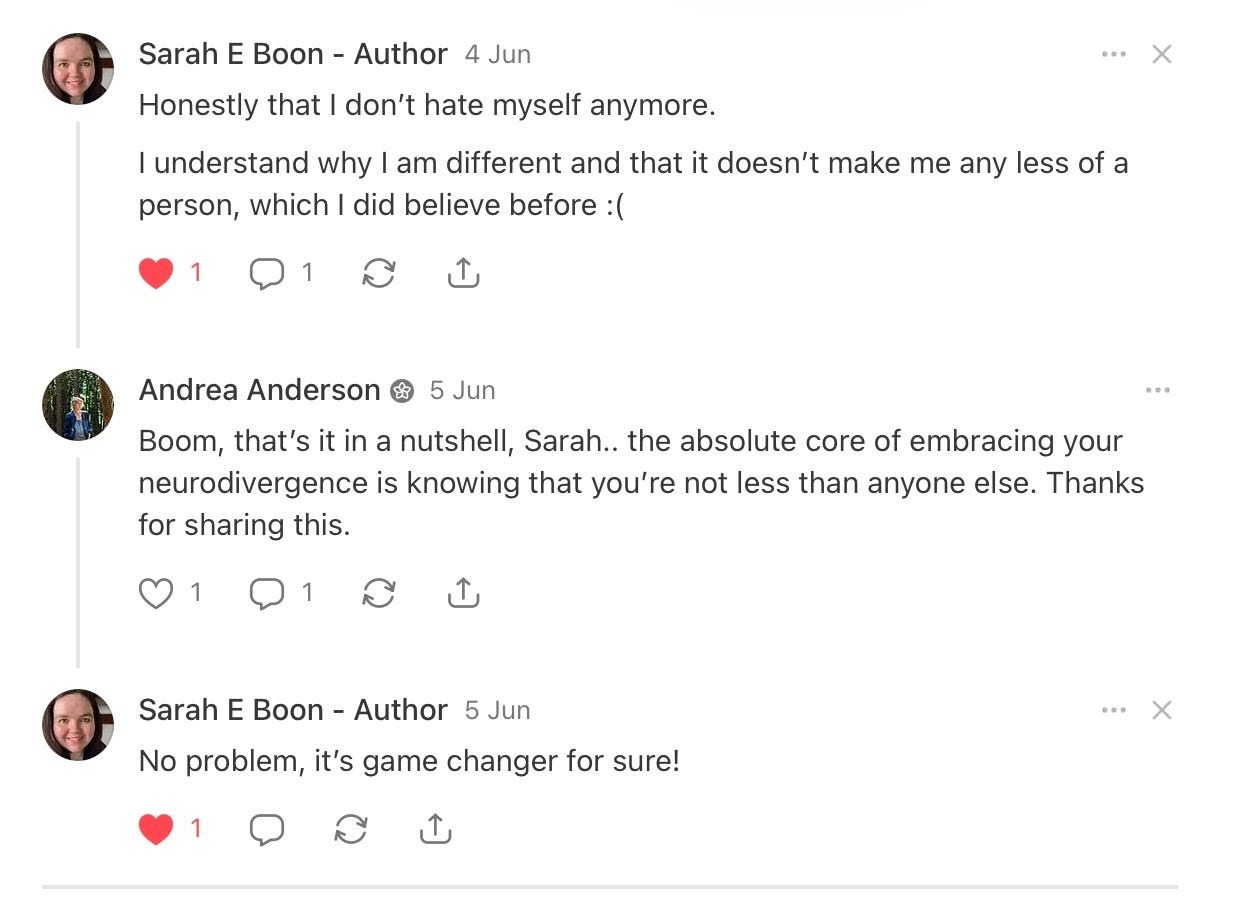
I think that not hating yourself, or learning to believe in and value yourself, is the nub of why it matters so much to understand and embrace your neurological difference.
If you want to add the best thing that’s changed since embracing your neurodivergence you can do so here
Self Esteem is more than a mantra
Self-esteem is not a mantra or an affirmation, it’s not something you do. It’s something that grows.
It starts with the belief that you too are worth having wants, needs and desires just as much as everyone else. Along with expressing them and taking action for these things to happen.
Make no mistake, I know from my own experience, it’s hard to fully digest that making life easy for others has made it hard for yourself.
It’s difficult to finally speak truthfully about what you really want in your life and what you don’t.
It may mean big changes for you and those who will remain a part of your life.
For a long while I’ve had a hunch that growing my self esteem would play the biggest part in living my life well. I’m starting to experience that my instinct was right.
I wrote a couple of articles on Self Esteem last year:
Redeem Your Esteem - how self esteem differs to confidence
This one in particular How to grow your esteem - is jam packed with helpful resources, thought provoking questions and tips. It includes a conversation with my friend, who is an excellent ADHD Coach, Bianca Faricy.
You’ll need to pay to access these - the articles and you are so worth it.
Are you here to continue learning how it feels to live well, beyond neurodivergent discovery? Join us in becoming a paid supporter (i.e the cost of a cup of coffee each month) it’s gives you access to everything in the archive and is massively appreciated.
As always, I’d love to hear your thoughts on this.
What struggles do you have with building and maintaining your self esteem
What helped you to grow in self esteem?
How is growing your self esteem helping you to live your life well?
Thanks for reading.
Andrea x
P.S Emma Svanberg has been writing a series of excellent articles about fawning if you do want to delve deeper into this topic.
And Alice Bramhill also has excellent articles and resources on this topic too.
Thanks for reading Belong...we are neurokin! This post is public so feel free to share it.